Maps: a Failed 100 Day Project
What makes a good 100 Day Project? Previously, starting on 1st September 2022, I’d successfully finished a 100 Day heraldry quilt project. While I didn’t make a square design every single day of the 100 days, I did have 100 squares by the final day, 9th December, and I managed this despite being very busy, and seemingly without any ill effect. In fact, if anything, it had been beneficial for me to do this daily task.
Failing to reflect on the reasons why, to my amazement, I’d managed to meet a self-imposed deadline that had zero external enforcement or pressures, I decided that putting myself under a lot of internal pressure with a daily task for a long-is but limited time was now something I could do.
And so, in September 2025, I set about preparing for a new 100 day project that would begin on October 1st. I love maps. I’d make a map every day for 100 days. Easy!
. . . But what if it gets boring? What if I start to hate doing it? What if the things I make are crap?
I had to insulate myself from failure.
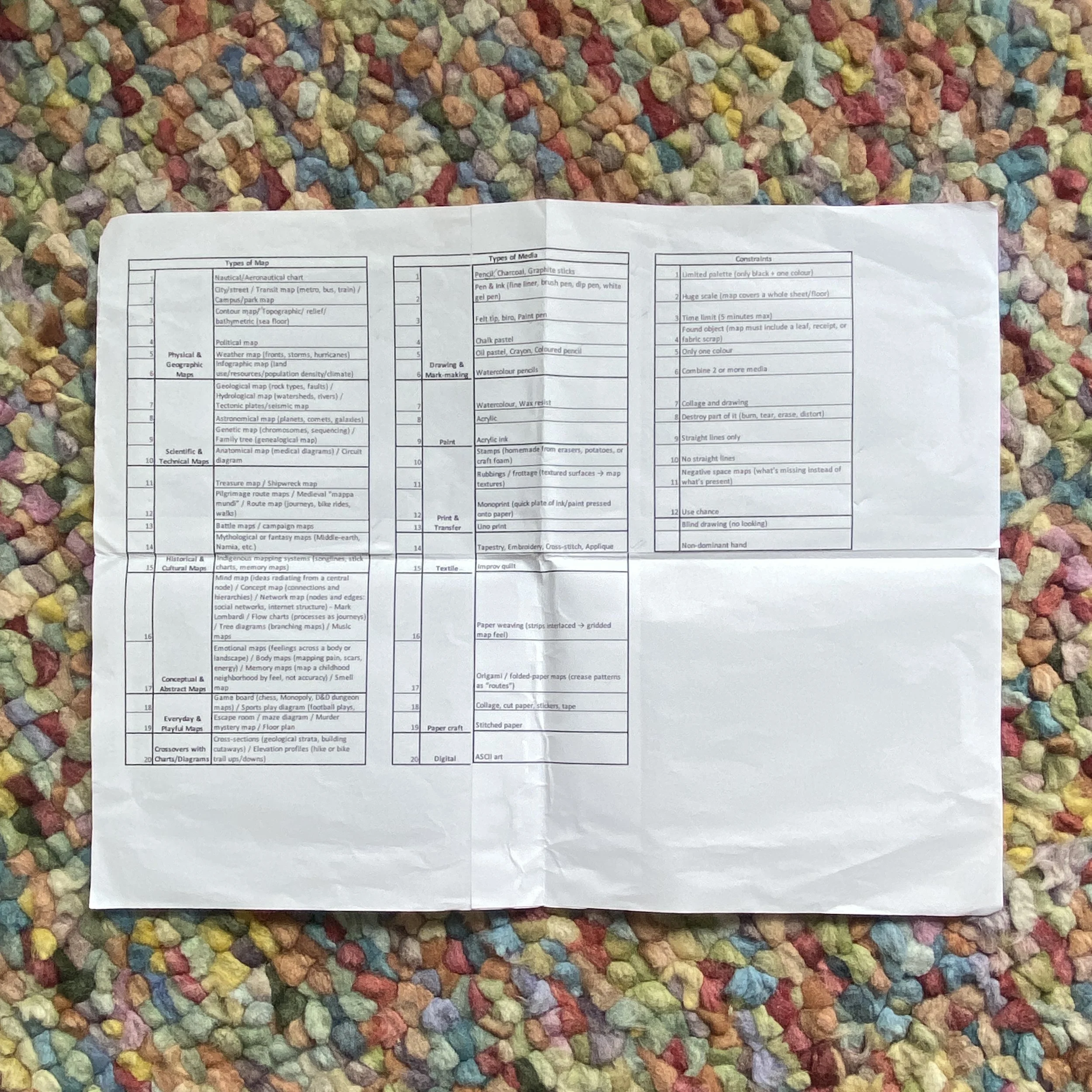
What do you mean you don’t create four-page spreadsheets to help you do art projects?
I listed different types of maps. Now I wouldn’t get bored! I got excited. I did more research. The list grew. It kept growing. It became preposterously long. I had to organise some maps into categories so that the disorganised list didn’t become overwhelming.
And what about the medium? I should change that too! After all, there were maps I’d thought about creating for ages. This gave me a reason to make them! (We will return to this sad statement in due course.) Naturally, the list of media also became massive. So massive that it was overwhelming. How would I ever choose the map type and the medium from such huge lists? The answer was clear: chance! As an irregular player of Dungeons and Dragons with a penchant for pretty dice, I was delighted to shoehorn in an opportunity to make use of my too-big-for-someone-with-my-level-of-experience collection of dice.
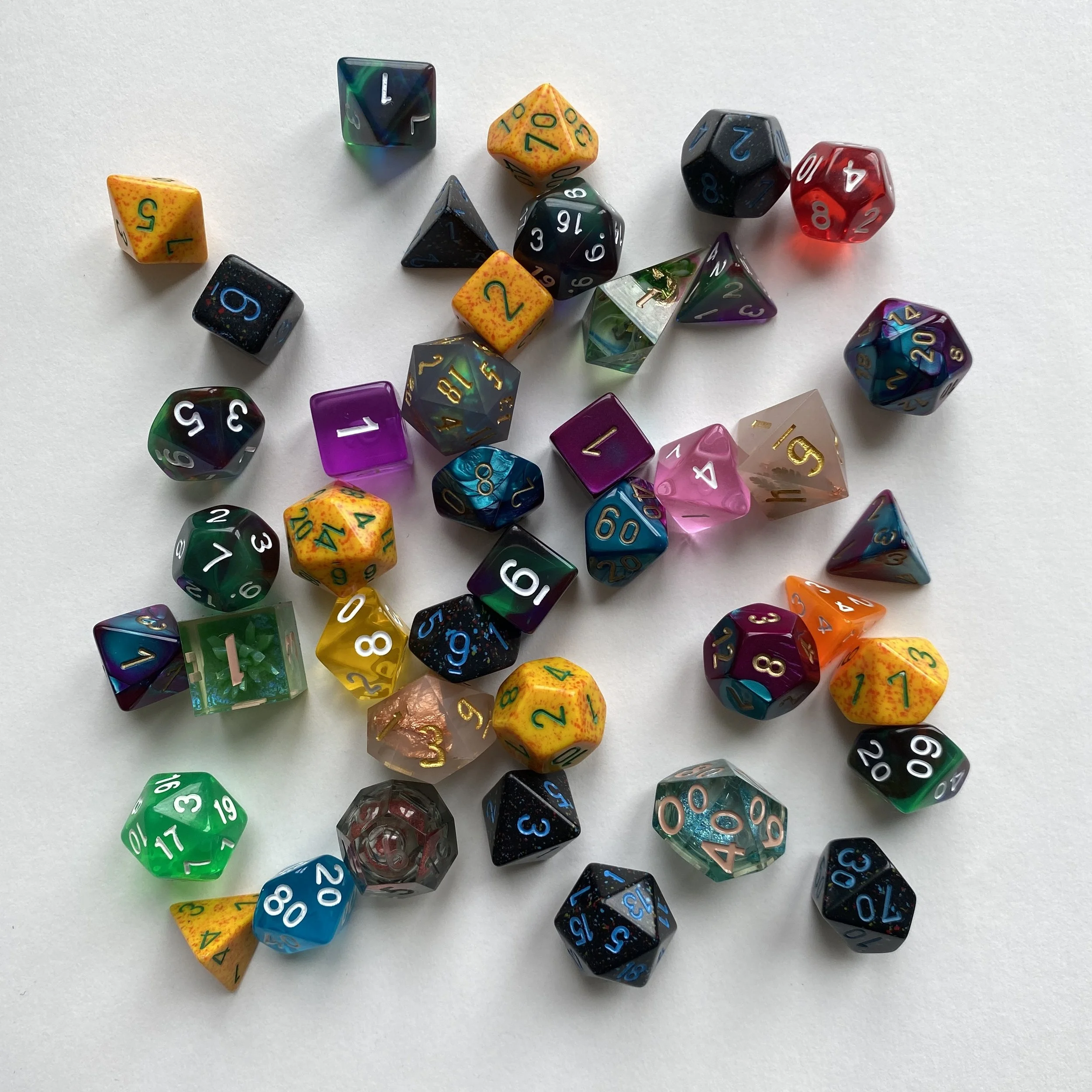
Six sets of lovely, lovely dice, with seven dice per set. Because it takes time to specify the “twelve-sided die” or “twenty-sided die”, players say “D12” or “D20” instead. This often leads to confusion when someone says something like, “You take six D8 points of damage,” because that sounds very much like sixty-eight. What larks!
And so the long list of map types was categorised into twenty themed areas, and I did the same with the long list of media. And then I decided, “Constraints are fun! I’ll add some of those too!” I listed twelve, because I have many twelve-sided dice. (And then another two. There is no D14, but oh well.)
By over-complicating the project, I thought I was simplifying it. All I had to do each day was roll two twenty-sided dice and one twelve-sided die. And then choose from the results, if needed. And then re-roll if something didn’t make sense or if I wasn’t going to have time for that particular combination. Oh, and then I had to actually make the thing.
Because I wasn’t going to make things easy for myself (this was honestly my train of thought), I decided I’d resist the temptation at some point to take the easy option of making a mind map of the word ‘map’, and that I’d add a “Day Zero” to create that. It would be a good start, after all.
The project began, then, on Tuesday, September 30th, 2025.
0. Mind map of the etymology of the word “map”, black pen on gridded paper.
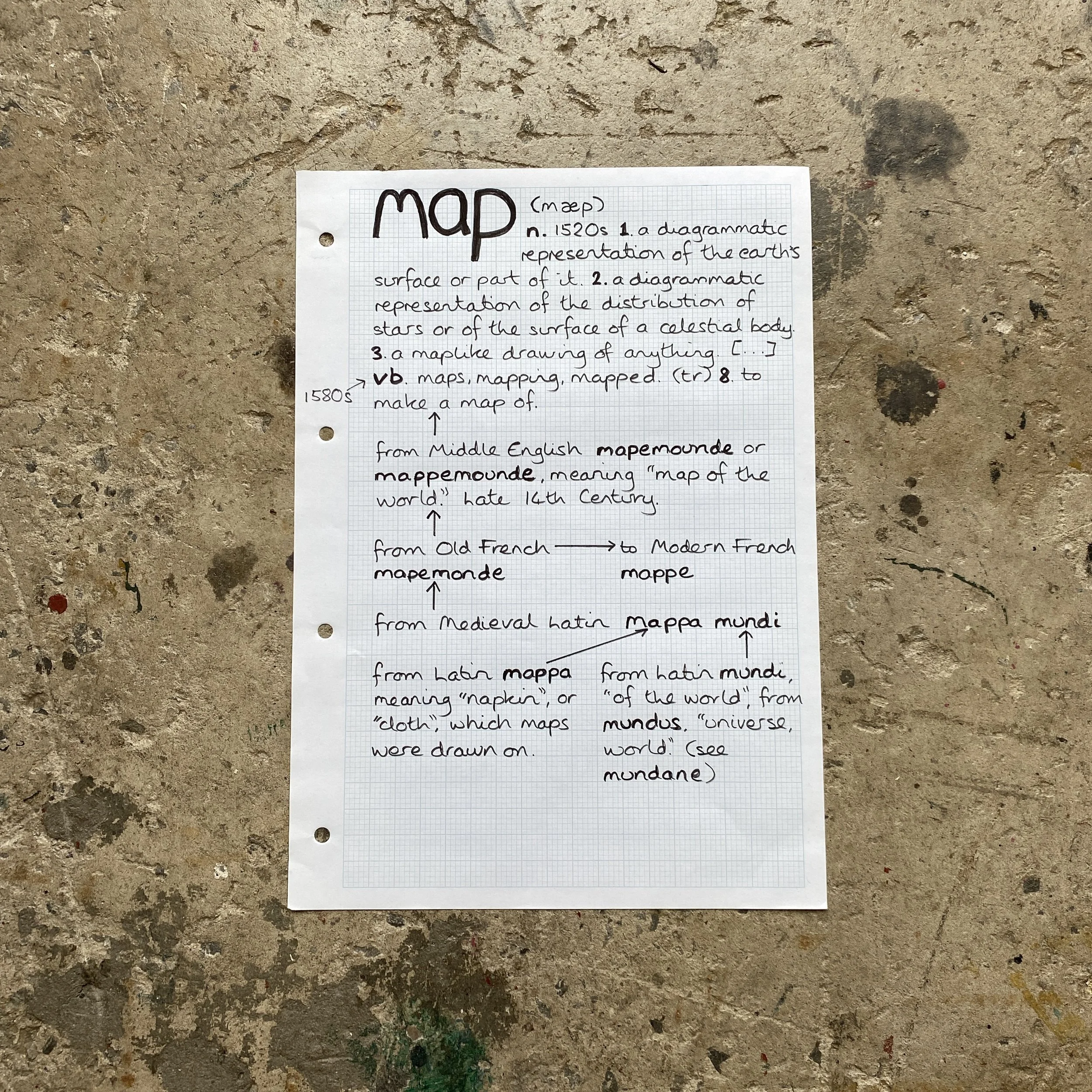
I learnt that “mundane” is derived from the Latin for “universe, world”. It’s fascinating that one word referred to both or either the universe and the world, and that this meaning is still present in some dictionary definitions, which refer to stars and other celestial bodies. This was especially pleasing since I was intending to make astronomical maps of some sort.
1. Crushed paper topographical map, pen and pencil on paper ripped from a roll.
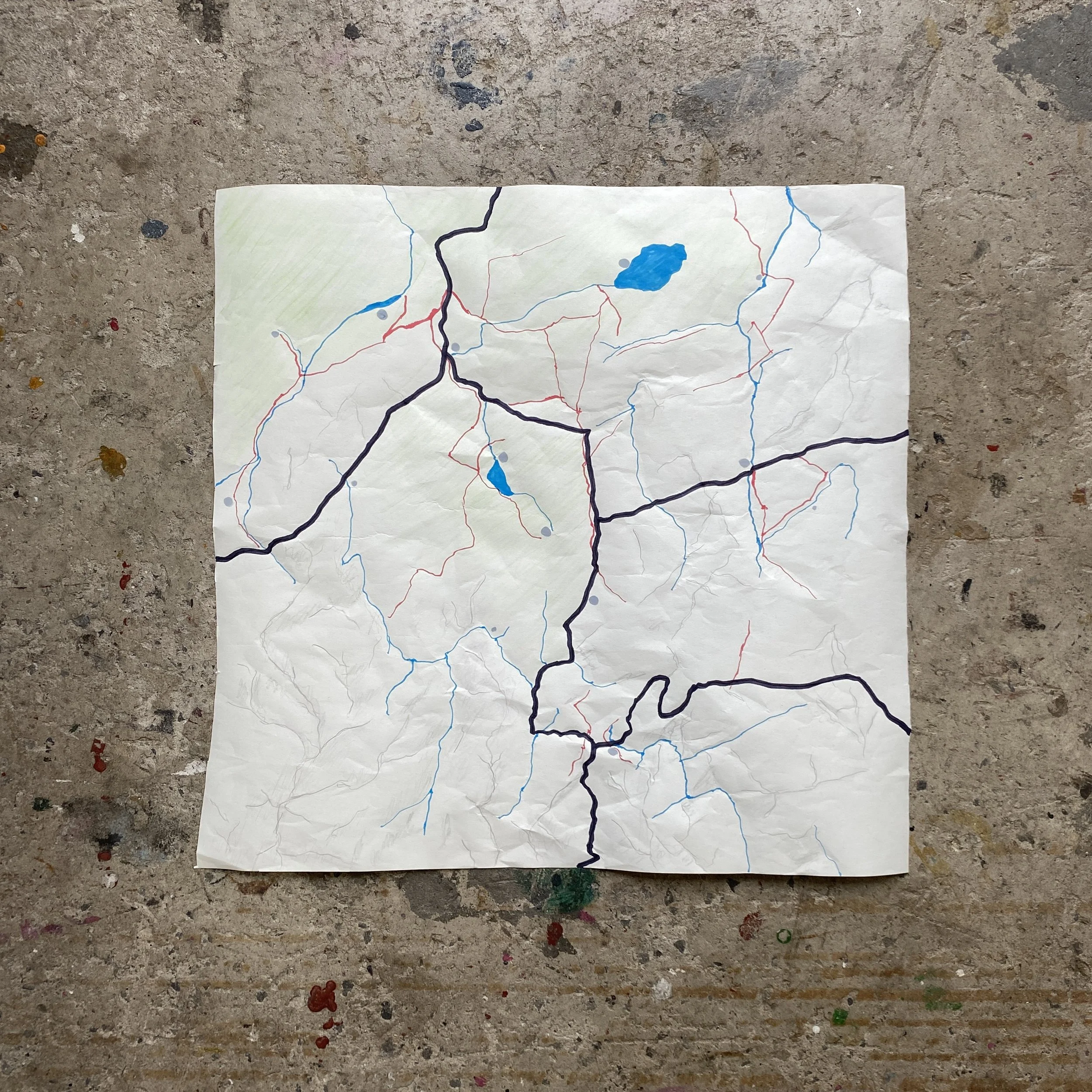
I rolled a 4 for “political map” and a 17 for “origami/folded paper maps” plus 12 for the “use chance” restriction. And so I leaned into the chance aspect and scrunched up some paper instead of folding it. Having done this, I decided a topographical map made more sense than a political map, and added water courses and a main road in felt tip pen. Then I went too far and added secondary routes (in red), and circles to represent settlements. I used pencil to add a bit of texture, and again went too far by adding grassland.
2. Textile battle map, paint pens and embroidery thread on sheeting.
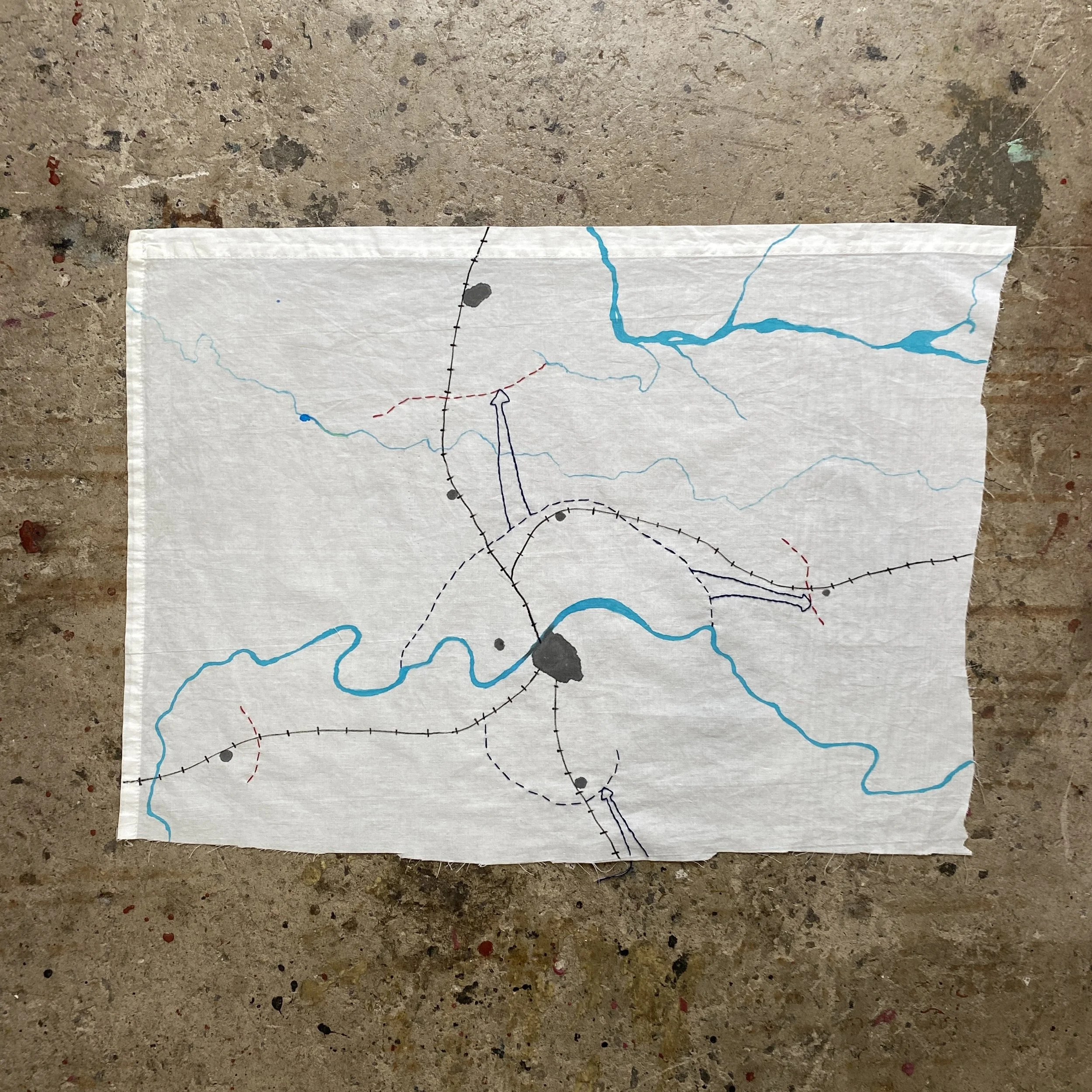
13 gave me a battle map, 14 gave me a textile of some kind, and 8 gave the ‘part-destroyed’ restriction. I like the graphics of battle maps, and accumulated a ton of source material that was all far too detailed for the time I had. This felt like a rush-job (and hand-sewing arrows was very boring), but I did enjoy drawing made-up rivers and letting the paint pen ‘bleed’ into the fabric.
3. Fantasy map, pencil on brown paper.
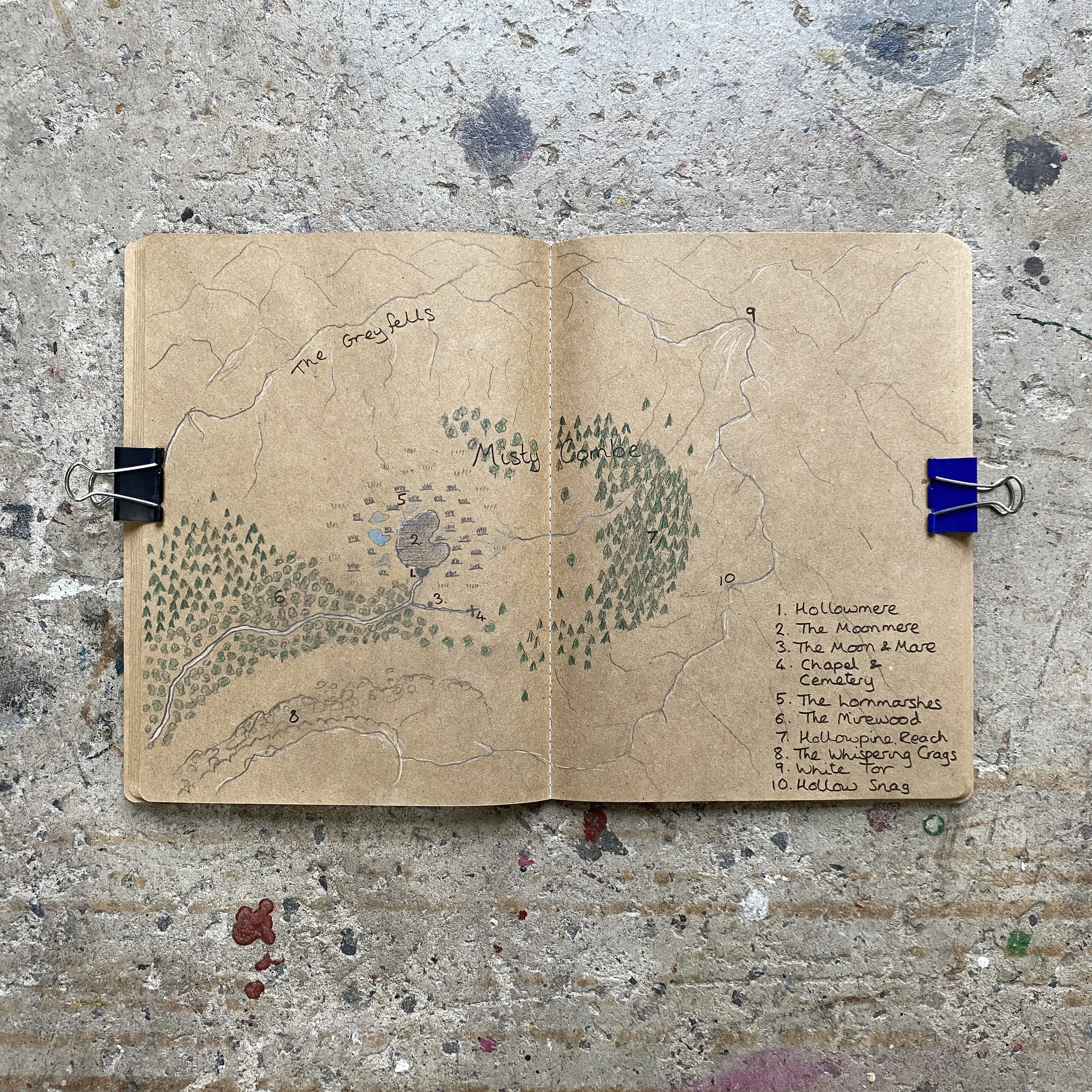
A roll of 14 gave me fantasy/mythological map, a 2 was pen/ink, and 10 told me “no straight lines”. How could I overcomplicate this one? By making a map that I’d actually use for a Dungeons and Dragons mini-game I’ve mostly written! That raised the stakes, and - again - I acquired too many reference maps. I even started researching the relationship between different types of biomes: can you get a bog right next to a deciduous forest? What about next to a coniferous forest? (And what is the actual difference between a bog and a marsh?) I abandoned pen for coloured pencil, and used brown paper in the centre-fold of a sketchbook. I don’t know why. It seemed appropriate. I don’t think there are any straight lines.
4. Indigenous mapping system, paint pen on damaged curtain lining.
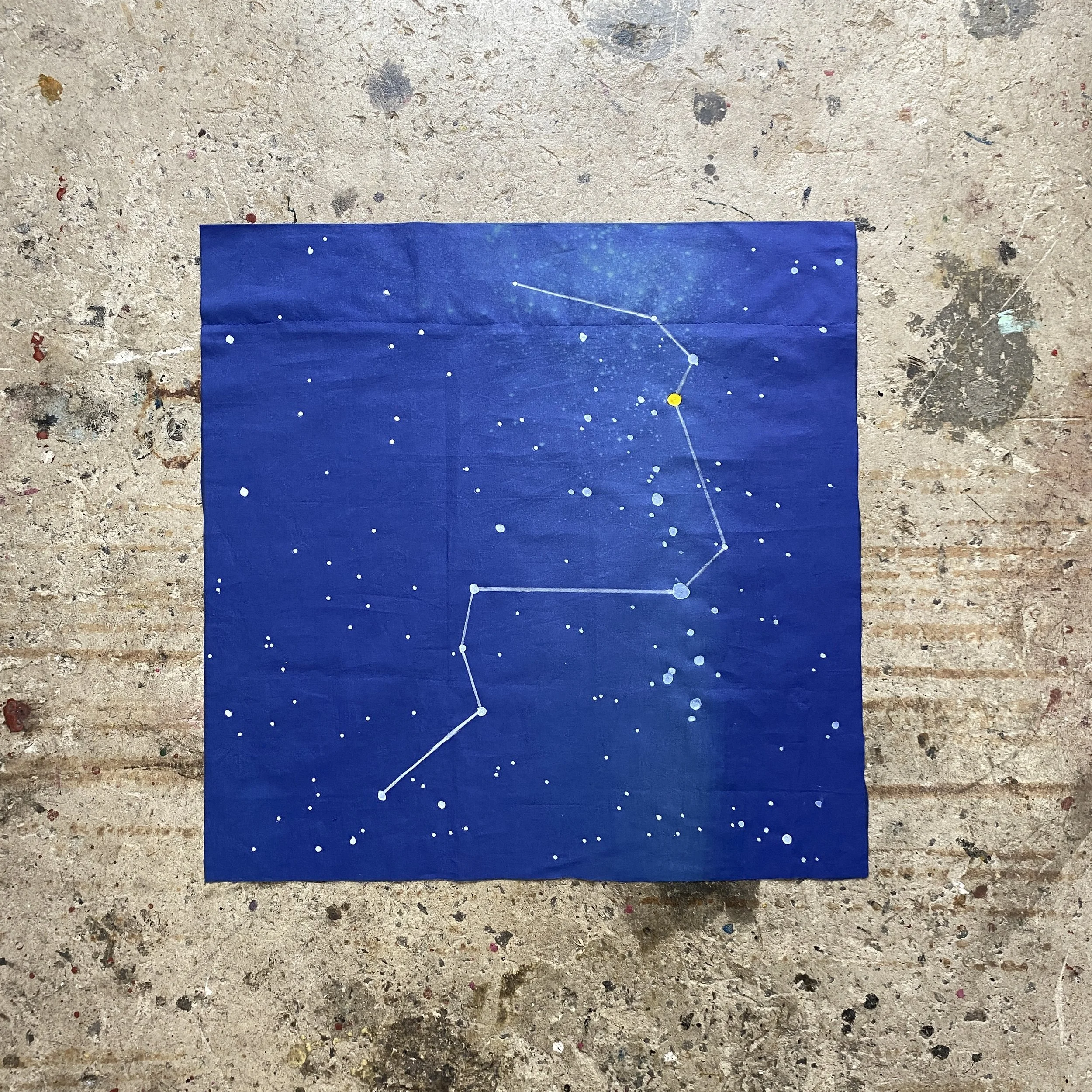
When it’s not your day job, perhaps a 100-day project shouldn’t involve the need for extensive research in order to make the daily thing? Maybe? The roll of 15 led to some fascinating learning though: about Aboriginal ‘songlines’ (https://walkingoncountry.com.au/what-is-a-songline/), and stick charts, and other kinds of memory maps. The idea I used was one such memory map, where people can remember routes by imagining connections between stars: a constellation that’s a real journey, with the stars as landmarks or key locations on the route. All navigation requires is bringing the constellation to mind.
This was supposed to be “18, a collage” and “6, combine 2 or more media”, but I had some dark blue fabric from an old curtain lining that I thought was perfect for a night sky. The way it had been sun bleached and marked with mould damage gave the impression (to me) of the Milky Way and far-off star clusters and nebulae. The stars are random assortments in paint pen.
5. Maze diagram, felt pen on paper.
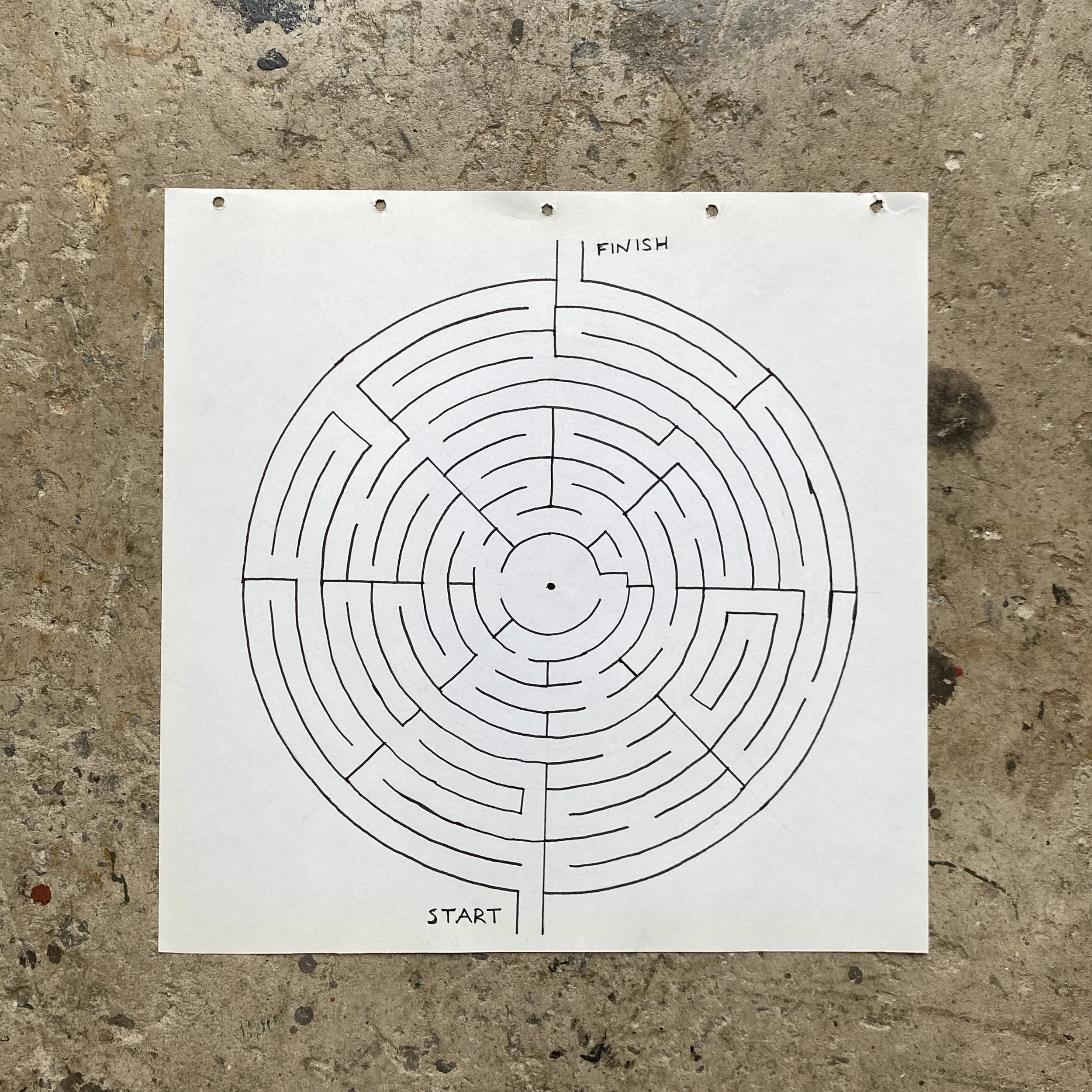
I love mazes. A roll of 19 gave me a few options, but I immediately plumped for this one. I ignored the roll of 8 that told me to use acrylic paint, and the roll of 12 that again told me to use chance. Again, I got lost in research, and my practice attempts showed me how hard it is to actually make a maze that has any level of challenge and doesn’t allow easy short-cuts. I went with a sort of mythological design in the end, which wasn’t my first preference, but I think I was influenced by the incredible tube map mazes by Mark Wallinger. I might make this again and draw it better, and properly erase my construction lines!
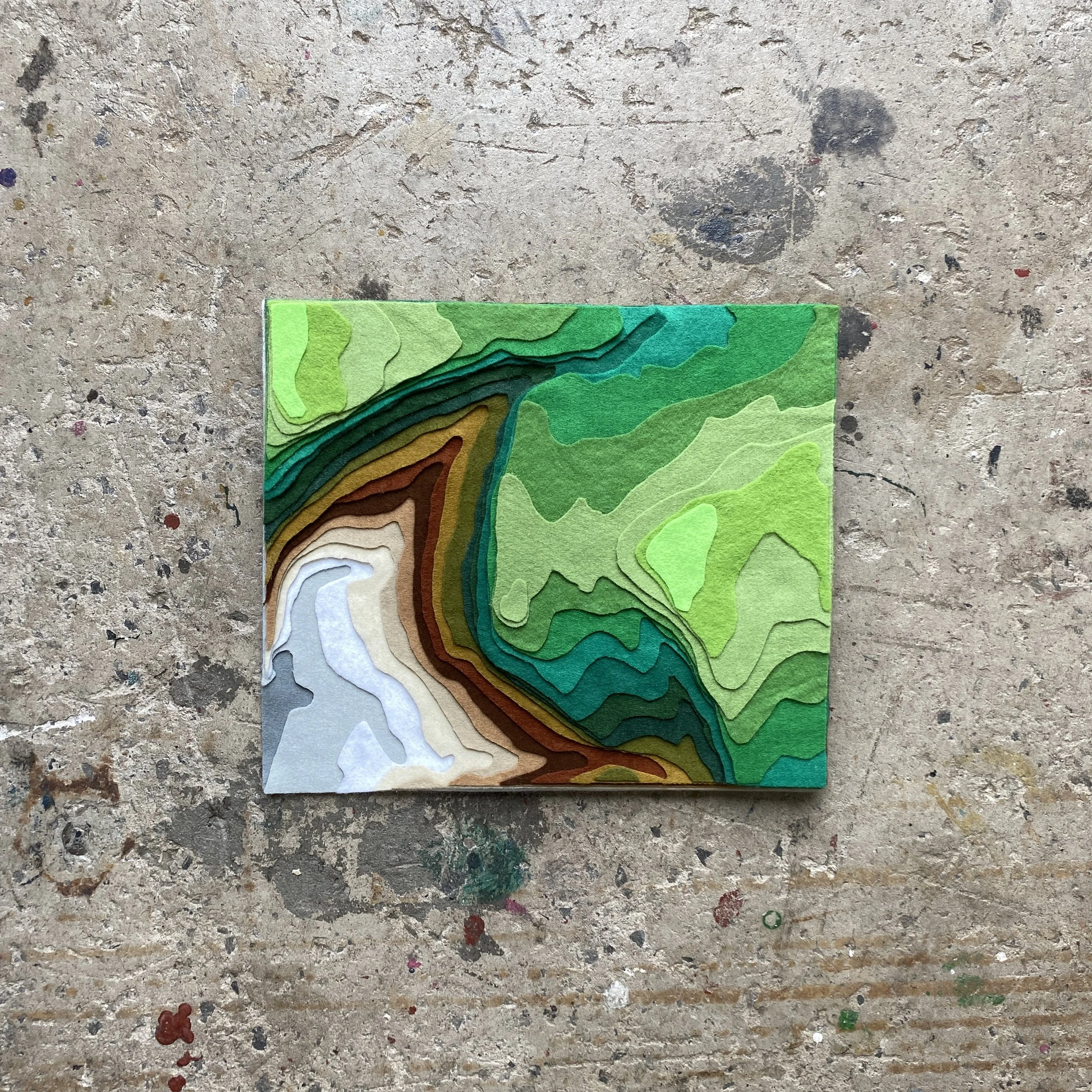
6. Contour map, glued felt.
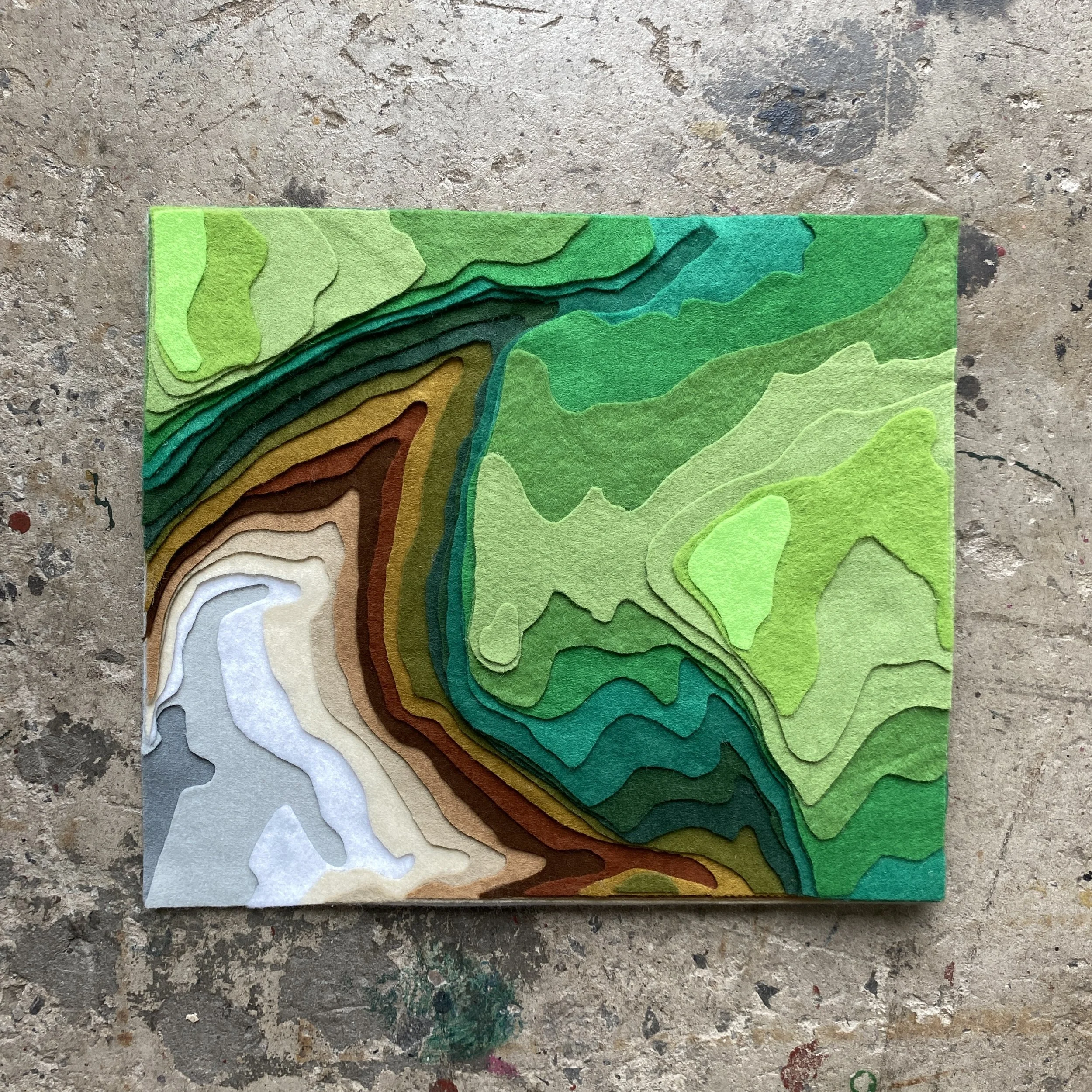
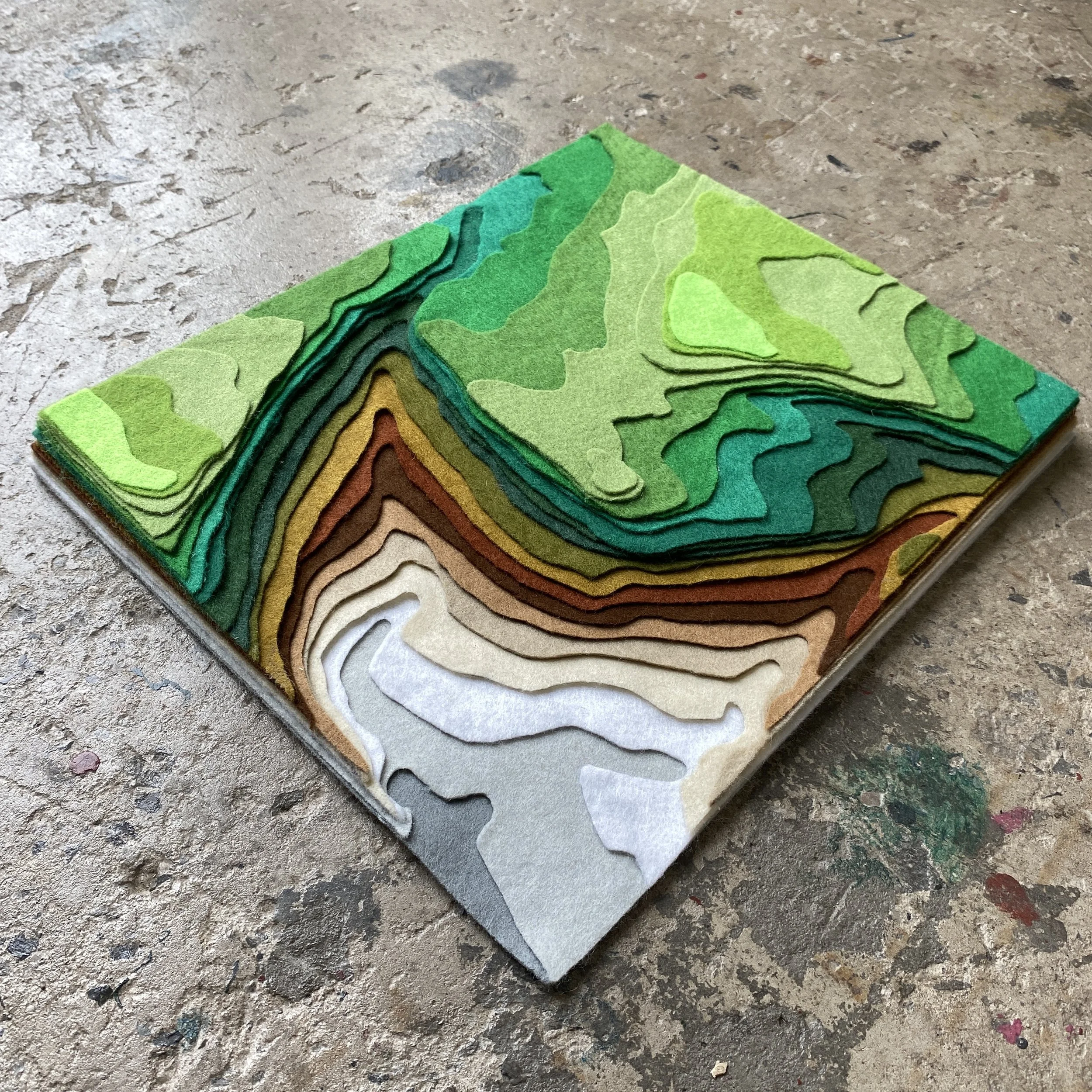
I rolled a 3 for contour map, and didn’t do any other rolls, because I was only ever going to make a contour map out of cut felt, because I’d wanted to make a felt contour map for literal years. Ridiculously, I’d been waiting to roll this option.
In case someone else needs to hear this because they’re as tangled in twisty thought processes as I clearly have been: you are allowed to make the thing you want to make.
Incredibly, I didn’t overthink other aspects of the map: the decision about which area to portray was actually easy, and I didn’t even spend much time thinking about the right scale or crop. That’s how I ended up with a felt contour map of Gardom’s Edge, measuring 11” by 9 “ by 1” at its thickest. I thought about adding rivers in embroidery thread, but decided not to after hearing other people’s opinions. I just glued the layers instead.
It took me 4 days. Unsurprisingly, it’s my favourite of the creations.
7. Chess diagram, paint pen on woven card.
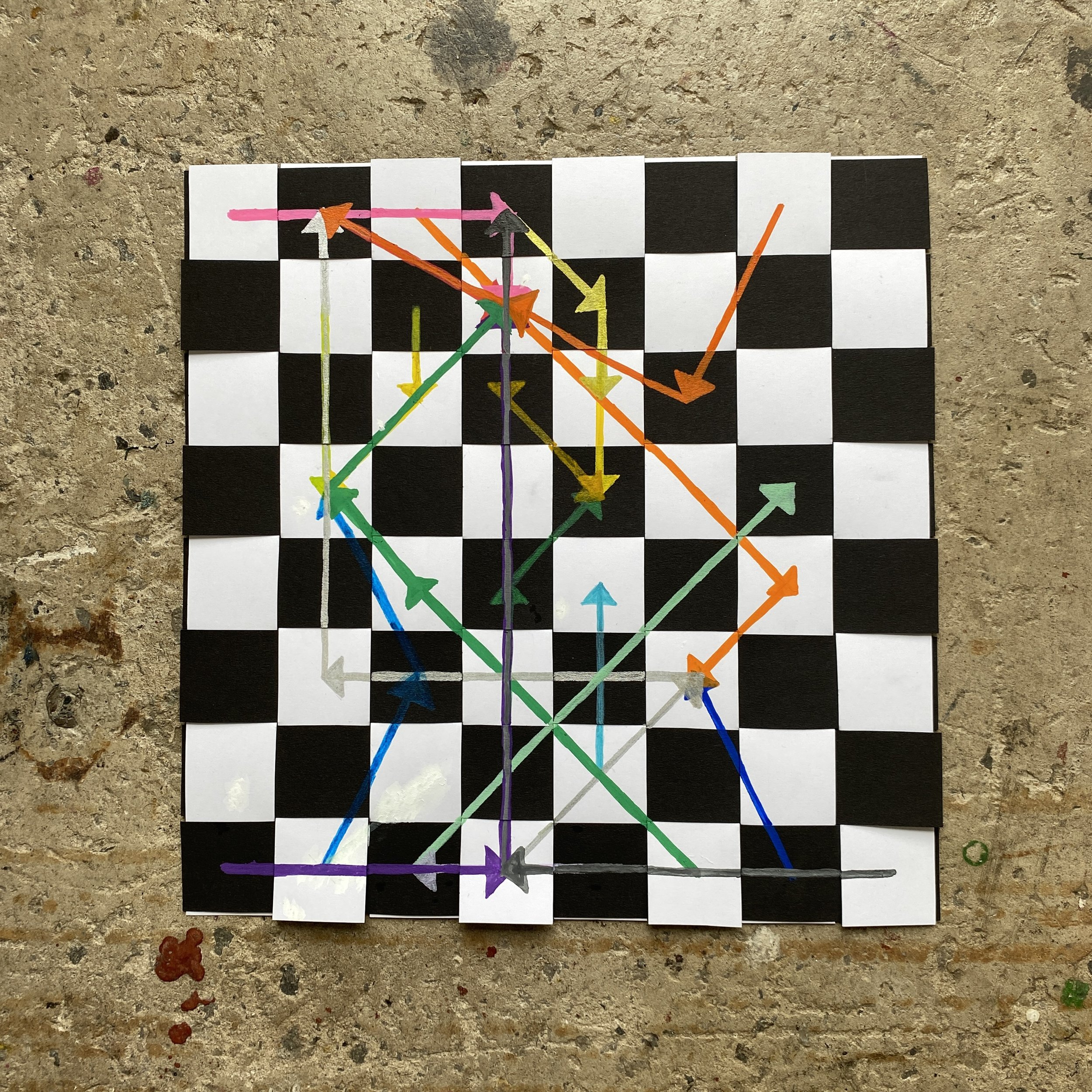
The dice (an 18 and a 16) told me to do a game board with woven paper . . . and no straight lines, which I instantly disregarded, because a woven paper game board clearly indicates a chess board. I don’t want to be repetitive, but I had also long thought about trying to represent a chess match diagrammatically. I’d expected I’d do this digitally, and the fact that the roll of the die gave me paper weaving as a medium was a joyful coincidence.
Of course, I still did research, because I wanted to use a famous game, but one that didn’t have too many moves or involve too many pieces (since I wanted to use different colours to represent different chess pieces). I went for the apparently famous Opera Game of 1858, between the America master Paul Morphy (playing with white), and two aristocratic amateurs playing as black: the Karl II, Duke of Brunswick and Comte Isouard de Vauvenargues. The game was played in one of the boxes in a theatre, the Salle Le Peletier in Paris, while an opera was being performed on stage, hence the game’s name.
I used different coloured paint pens to represent the movements of different pieces, vaguely trying to colour code each side, with cooler colours for black and warmer colours for white.
Can you follow what happened based on the diagram? No, not remotely. Would even Magnus Carlsen, grandmaster of grandmasters, be able to recognise the game from this confusing portrayal. It’s doubtful.
8. Astronomical map, coloured stickers on card.
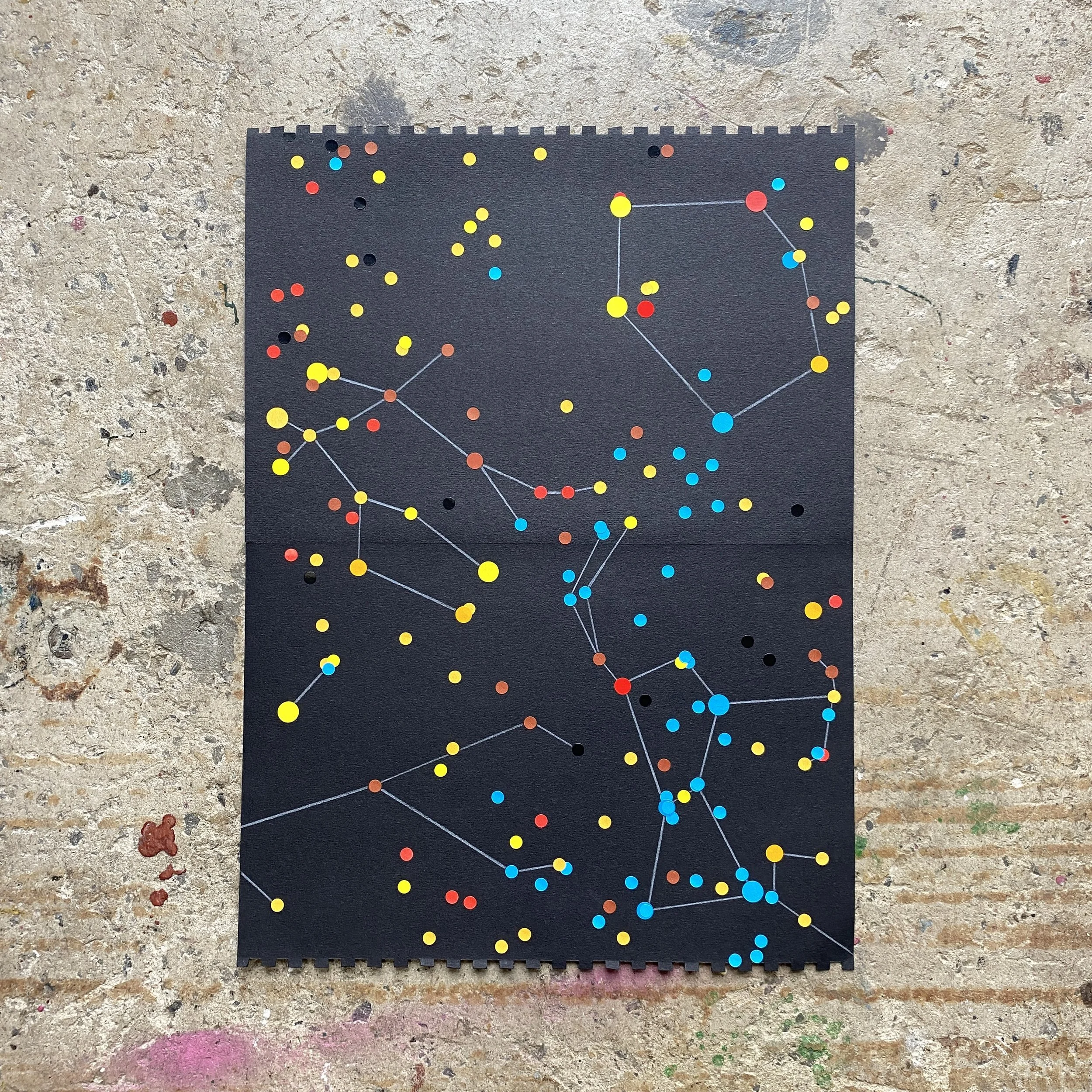
I love space, so I was glad to have the opportunity to make something more accurately representative of the night sky. The dice told me it should be made with stamps, but coloured circular stickers of various sizes seemed a good compromise. It was surprisingly finicky to make for something that looks so child-like, but it was enjoyable.
9. Secret Tesco street map, photocopied A-Z collage.
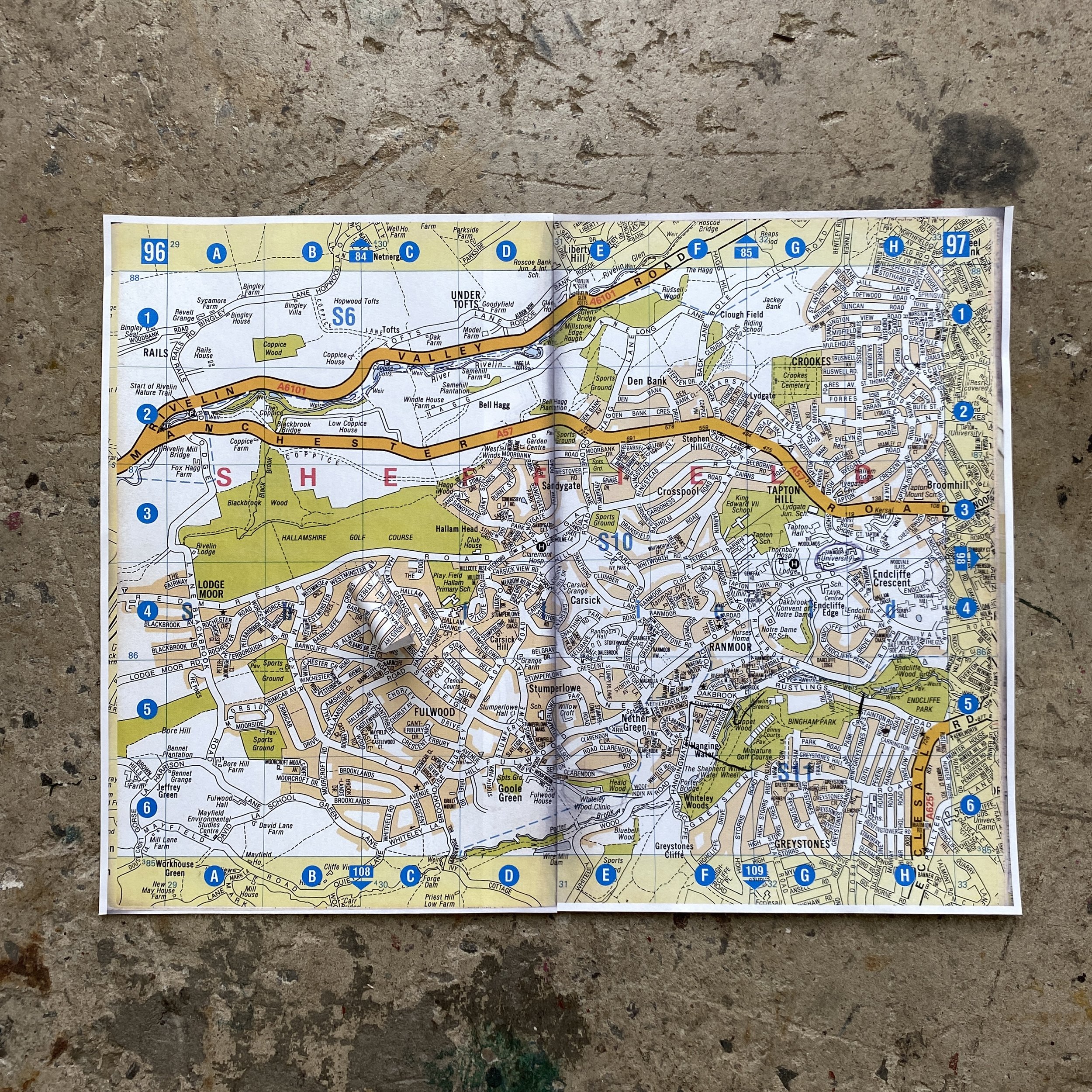
I rolled no dice for this. I just needed to make something quick to try to catch up because I was still in denial, however ridiculously far behind I was at this point, and was sure that I could complete the 100-day challenge.
What on earth is this weird map about? It aims to capture the inability of my mind (and no doubt many other people’s minds) to really understand how parts of a city match up, especially in more unfamiliar areas where you tend to only travel down main roads and the areas beyond could contain all manner of unknown things.
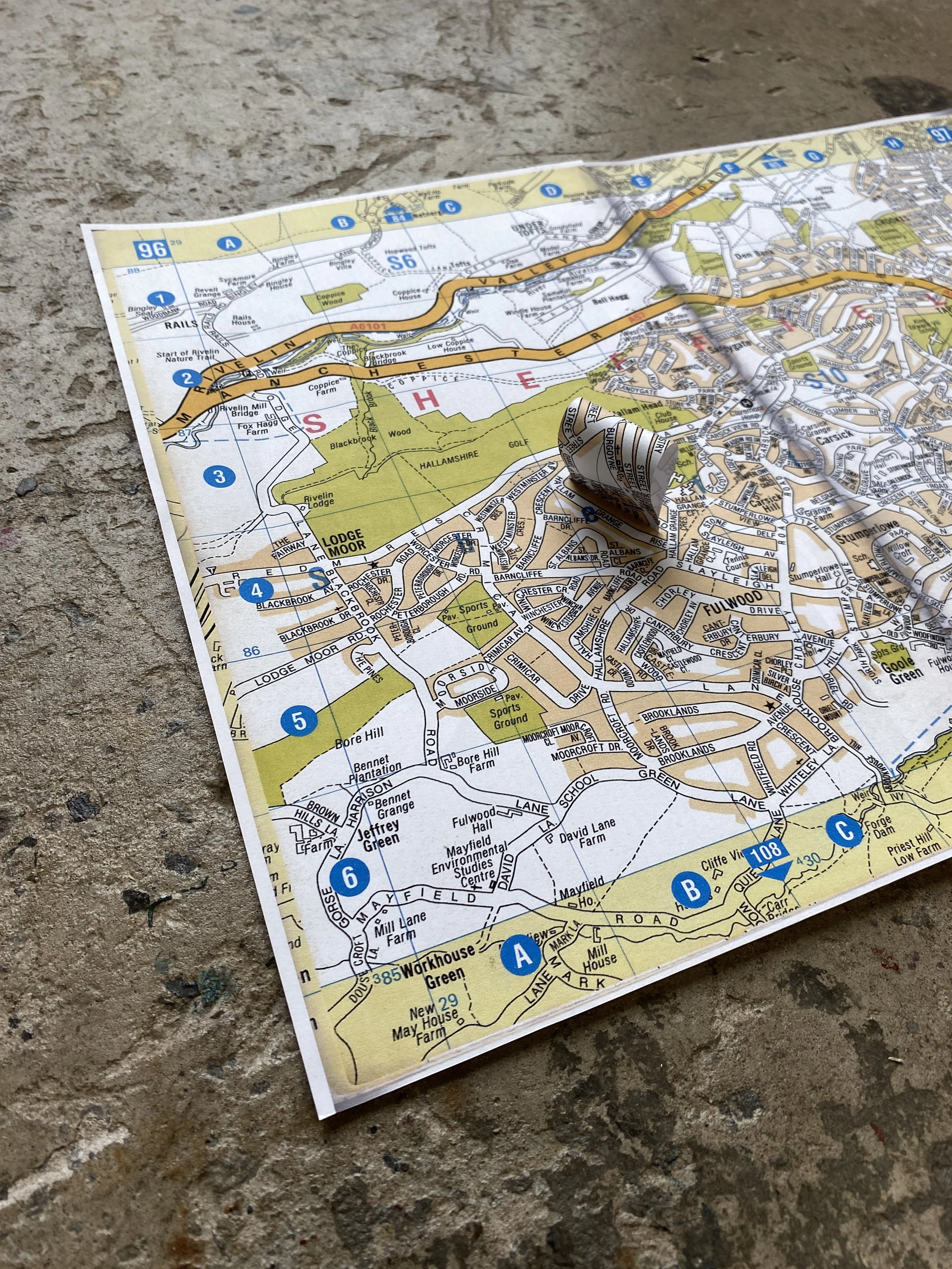
In this case, having seen people with Tesco shopping bags in Fulwood, my brain told me there must be a large Tesco supermarket hidden somewhere in the suburbs. Where was it? I didn’t know. I just assumed there was a huge gap in my mental map where it existed. (After all, the Netherthorpe Tesco is sort of hidden!) Finally, I realised that the Tesco bags came from the small Tesco attached to the petrol station on Fulwood Road that I’d driven past many, many times and had literally been inside. There was, in fact, no secret Tesco. Where would it have been anyway?
By photocopying the A-Z page and making an intervention, I added an Inception-esque geography-defying area where my secret Tesco could have existed (or perhaps still exists).
10. Weather map, stitched fabric and paint pen.
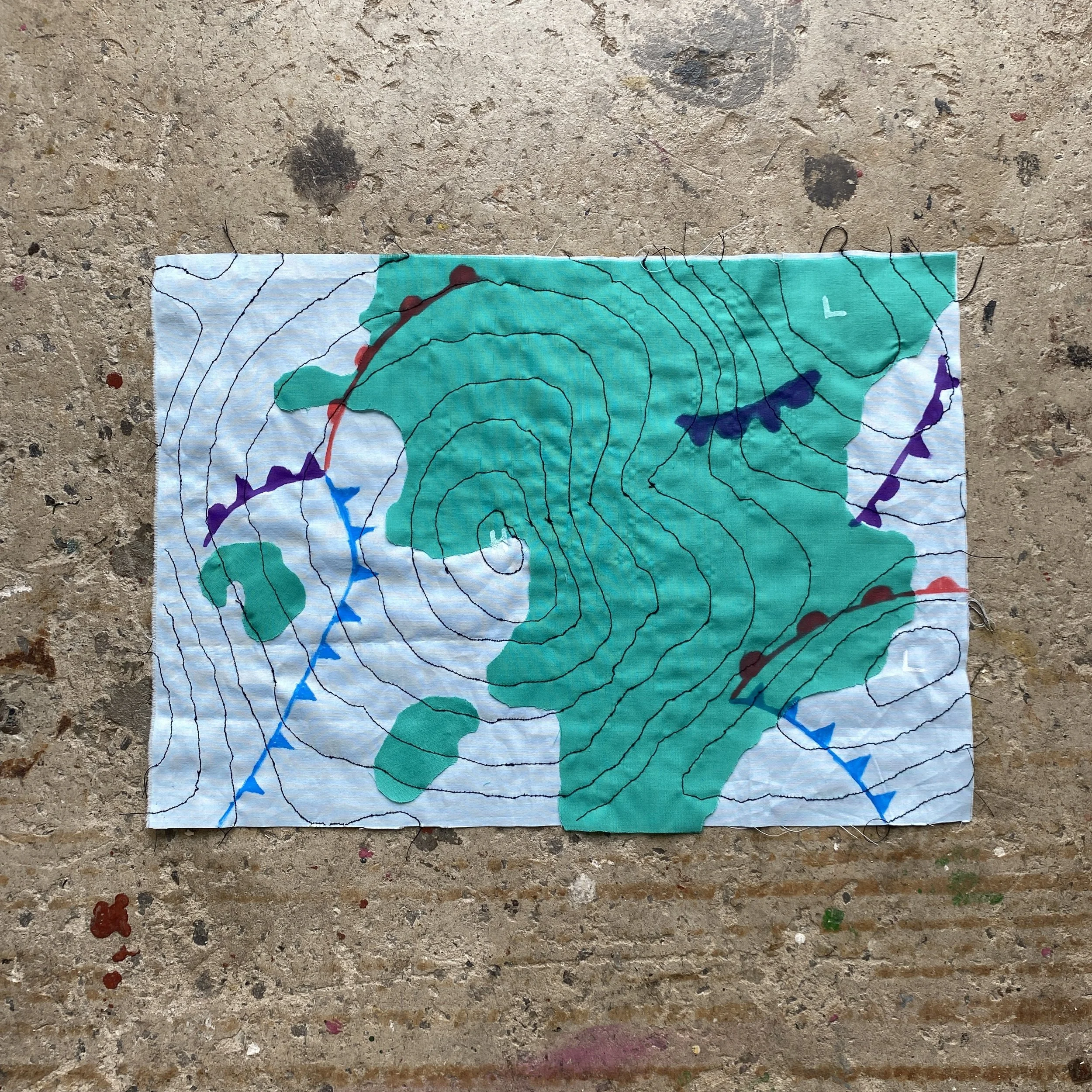
Weather maps are fascinating. My incarnation was not. The dice said to stitch this on paper, but I used free-machine stitching on fabric instead, then I added some cold and warm fronts in paint pen, and this time bemoaned the fact that they bled and became shapeless.
11. Shipwreck map, collage and ink stamps.
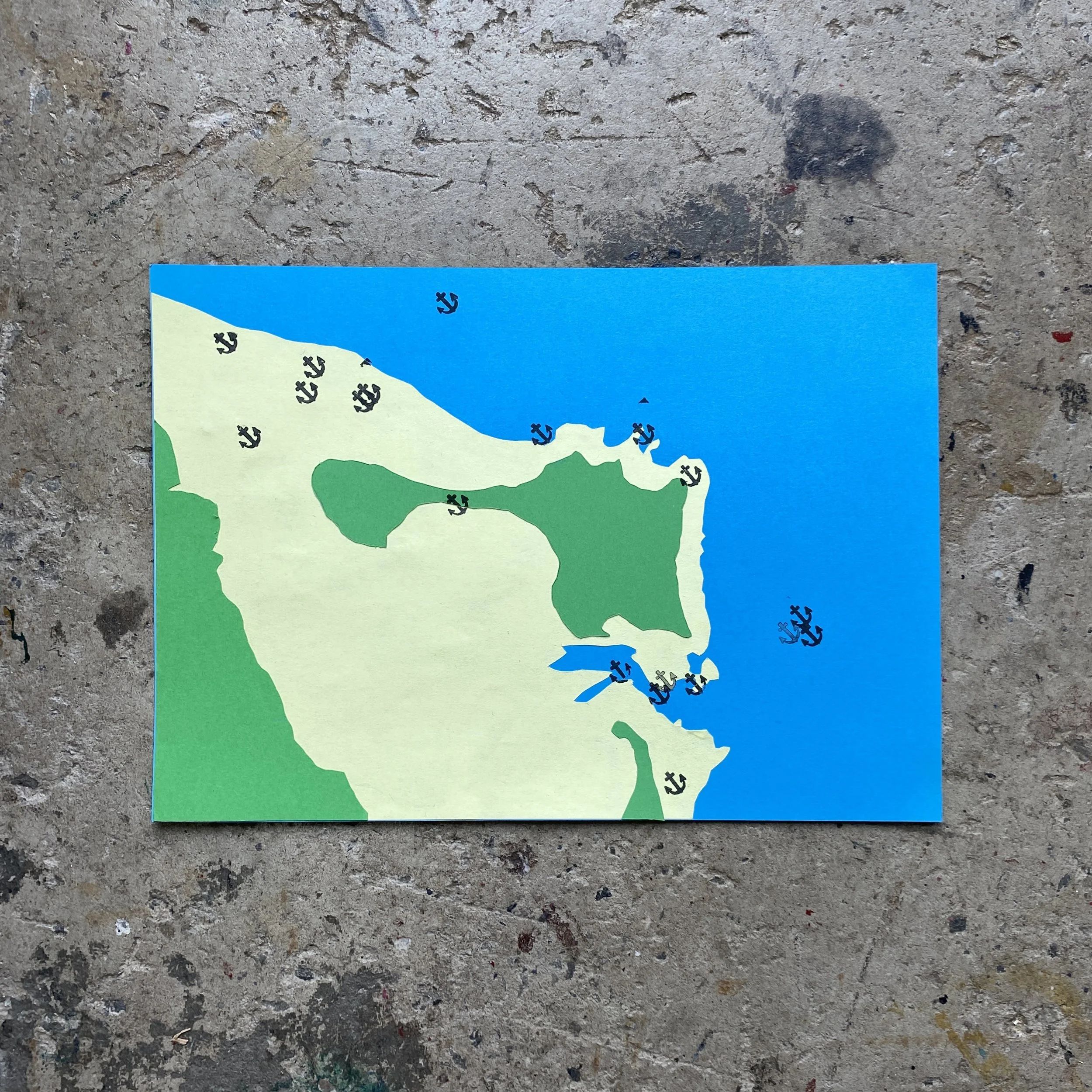
I’d lost all motivation by this point. I don’t think I even rolled for a medium, let alone a restriction. I just wanted to get a map done.
Holy Island is one of my favourite places, and I’d previously seen maps showing the numerous shipwrecks surrounding the island. I looked them up on this great-but-buggy site, and used stamps to represent the wrecks after I’d made a collage of the island in card and paper. I had no ship stamps, so an anchor was the nearest nautical thing. An imperfect choice, emphasising my wish to just get it done. Holy Island and its ship wrecks deserved much better.
The Point of Failure
And so, I finally realised that, with the list of maps I’d given myself, if I made something quickly, I’d find the result dissatisfying. But if I spent the time required on it, I’d be lucky to make even 25 maps in 100 days. I rejected that idea because the whole point for me was to create something new each day; without that very specific goal, I doubted I’d have the motivation to make anything. I gave up.
Mostly.
This March, I decided I’d like to try making something to submit to a gallery show which had the theme ‘water’. One of the maps I’d have liked to have made, but didn’t get to, was a hydrological map, showing only water courses in an area.
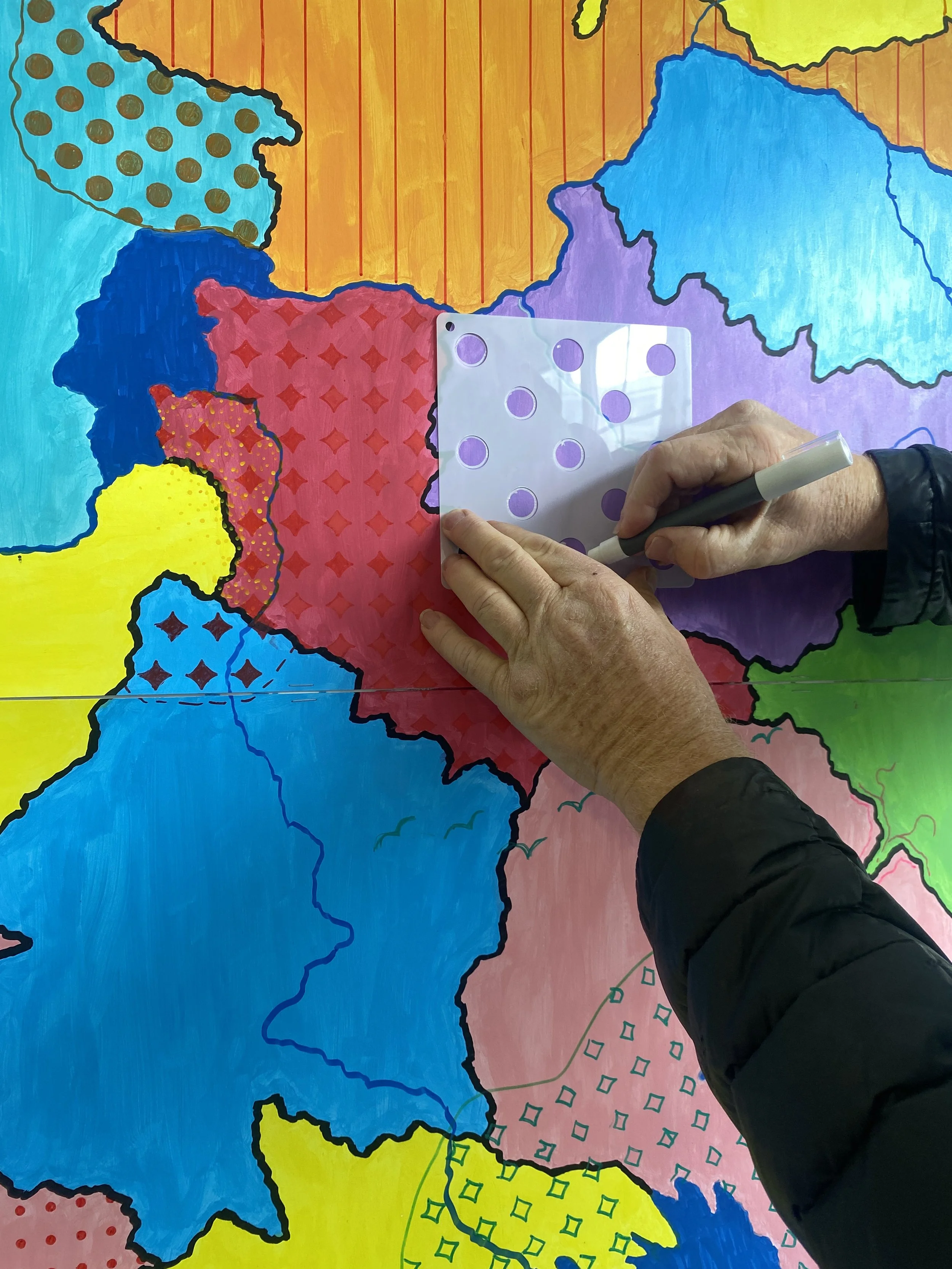
12. Hydrological map 1, acrylic ink on canvas / Hydrological map 2, paint pen on cotton sheeting.
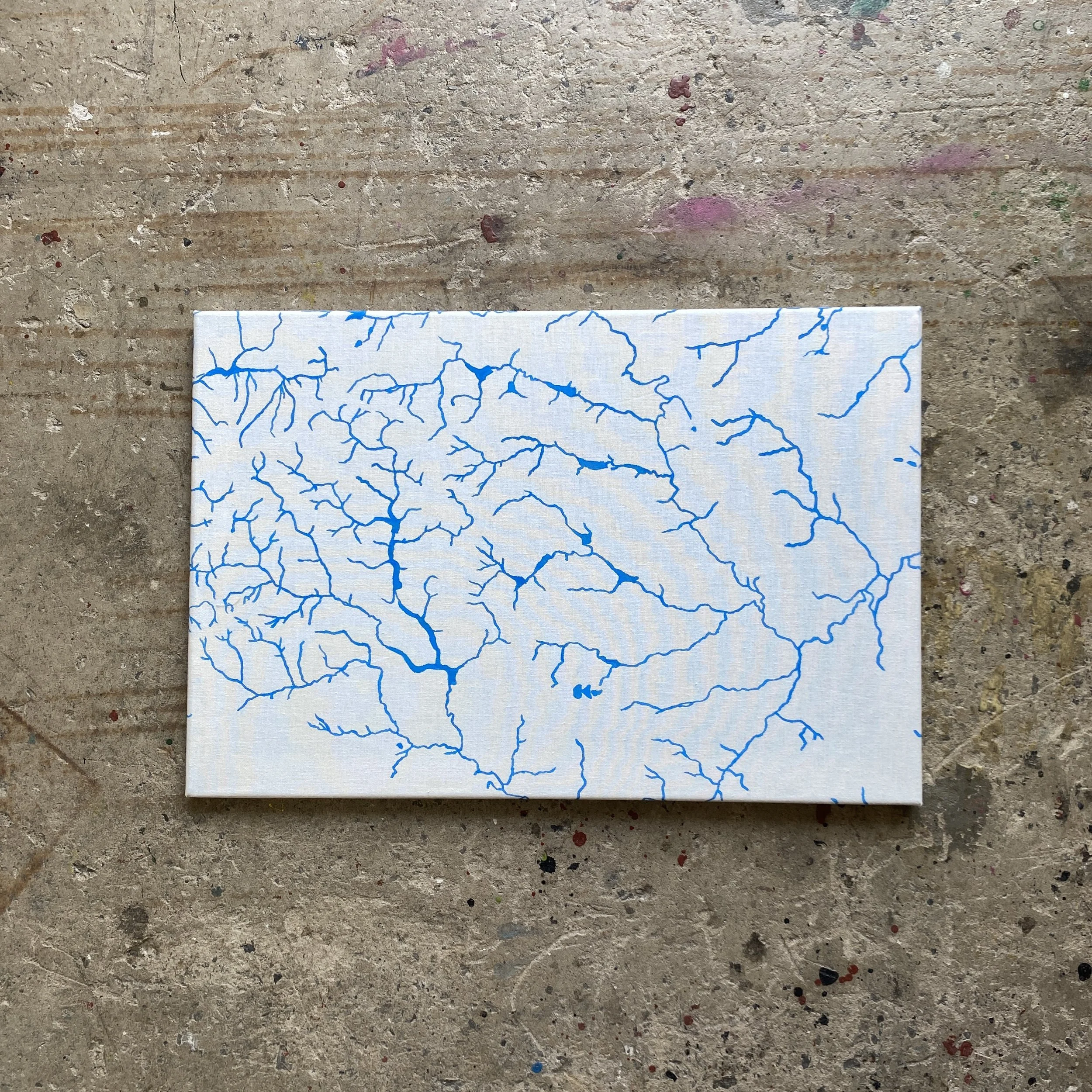
Hydrological map 1: acrylic ink on canvas, later stretched.
The rivers and reservoirs surrounding Sheffield, right into the Peak District, became my focus, but perhaps they shouldn’t have been. The hydrological maps that look best are islands or whole countries. There are no rivers that are cut off, going nowhere. Still, there are lovely patterns to be seen, and perhaps I’ll experiment further, either zooming out, or selecting a coastal area instead.
Needless to say, I didn’t end up submitting either of these to the gallery.
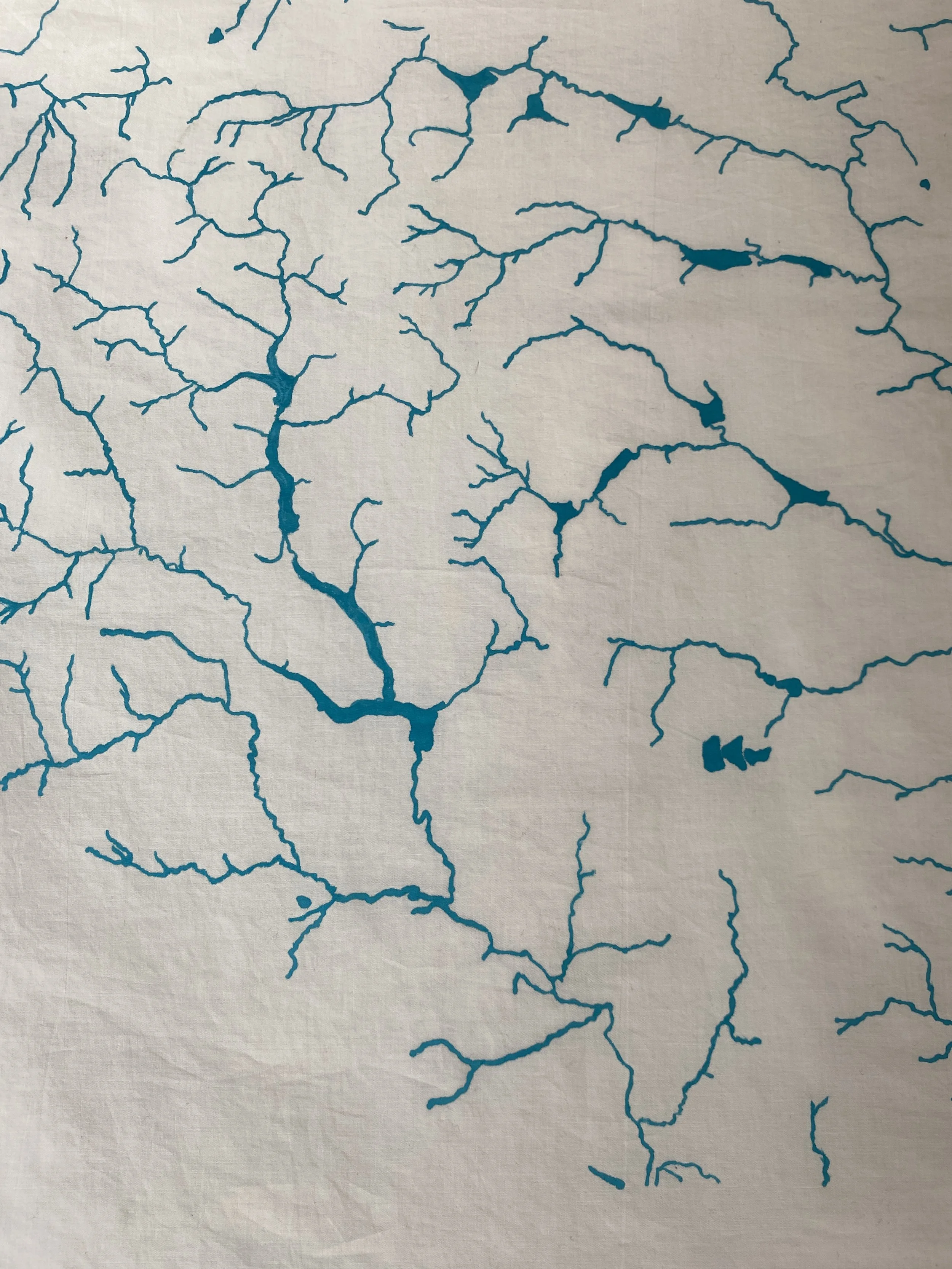
Hydrological map 2: paint pen on cotton sheeting.
The Evaluation
Why did the 100 day quilt project work so well and the 100 day map project fail? The parameters for the quilt project were the same every day: a 5 inch square that adhered to the rules of heraldry. They also combined to make a bigger whole, so I had the motivational factor of watching the project grow incrementally with each new square I stuck on my wall. Very little research was required, as the project was the result of research I’d already done without knowing what it would lead to. I’d followed an interest for no reason.
A map is more complicated than a basic heraldic shield, but it doesn’t have to be. There are still maps that I’d like to play around with - nautical maps, treasure maps, geological maps (naturally) - but each one of those could be a 100 day project in itself. Repetition is part of the point, and it’s how you learn and discover things. Instead, I was so terrified of being bored by repetition and/or disappointed by simplicity that the complex system I made to protect myself from boredom inevitably caused me to fail. Or, rather, a complicated system I’d designed to insulate myself from failure precipitated that failure.
This is all very well. I’ve learnt something from the failure. But I’m sure there’s an 100 Day Map Project to be done, and I haven’t yet thought up how to do it.
Watch this space (if you have the patience, grit and determination of a glacier).